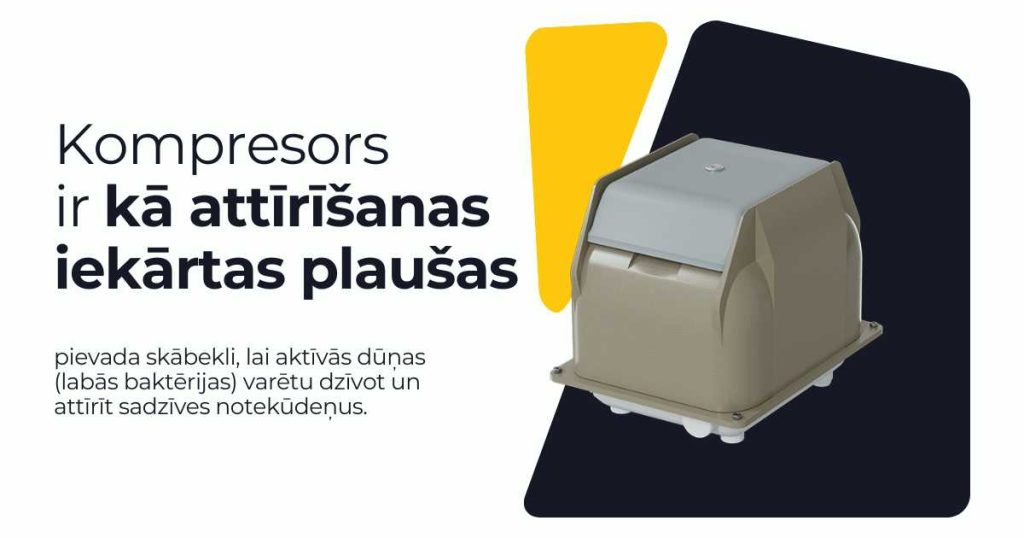
Compressor
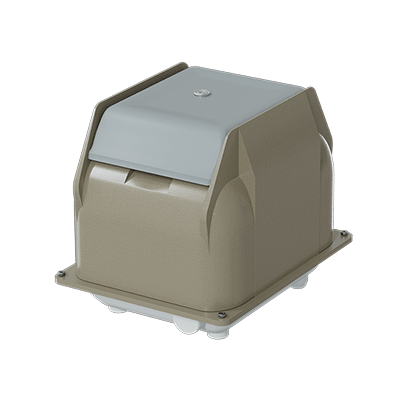
The Secoh compressor is a reliable solution for aerating wastewater treatment plants, providing a continuous air supply for biological treatment plants, pond aeration and industrial processes. High energy efficiency, quiet operation and a long service life are the hallmarks of Secoh quality.
Why choose
Secoh blowers?
Noise insulation
Thanks to a double layer of sound insulation and the housing design, EL series Secoh compressors run remarkably quietly.
Robust, heavy-duty design
The Secoh compressor is built to work at elevated pressure, delivering a steady air flow even at greater depths.
Optimised energy consumption
The Secoh compressor keeps power consumption reasonable while providing continuous aeration at minimal cost.
High performance
The mechanically treated water flows into an infiltration field or tunnels, where the natural filtration stage takes place.
How does an air compressor work?
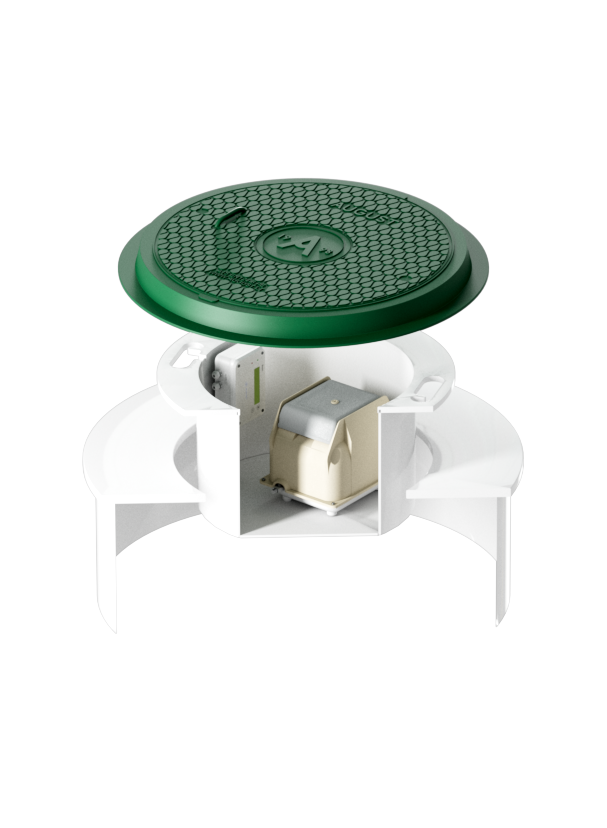
In a biological wastewater treatment system, the bacteria that break down pollutants need oxygen, just like any living thing. This oxygen is supplied by the Secoh compressor, which continuously pumps air to the diffusers (aeration elements) in biological treatment plants.
A diaphragm compressor works on a simple but very reliable principle:
An electromagnet creates oscillation. Inside the compressor, an electromagnet makes the diaphragm vibrate at high frequency.
The diaphragm pumps air. Each movement of the diaphragm changes the chamber volume, drawing air in on the intake stroke and pushing it on into the system on the exhaust stroke.
Valves control the flow direction. Inlet and outlet valves ensure air flows in one direction only, from the compressor to the plant.
Air reaches the diffusers. The compressed air reaches the diffusers in the treatment plant tank, where it is released as fine bubbles, keeping the activated sludge (bacteria) alive.
Secoh compressors are among the most widely used solutions for aerating small and medium treatment systems – compact, durable and available in different capacities to match the number of residents and tank volume.
| Model | Rated air flow (l/min) | Rated pressure (kPa) | Weight (kg) | Price (incl. VAT) |
|---|---|---|---|---|
| Secoh EL-S-60 | 63 | 14,7 | 8,5 | 180 € |
| Secoh EL-S-80-15 | 82 | 14,7 | 8,5 | 220 € |
| Secoh EL-S-100 | 102 | 16,7 | 8,5 | 260 € |
| Secoh EL-S-120 | 123 | 19,6 | 9 | 360 € |
| Secoh EL-S-150W | 158 | 19,6 | 16 | 480 € |
| Secoh EL-S-200W | 200 | 19,6 | 16 | 495 € |
| Secoh EL-S-250W | 240 | 19,6 | 17 | 750 € |
Biological sewerage compressor: what is it for?
A biological wastewater treatment plant works thanks to a natural process carried out by microorganisms. For these microorganisms to break down organic matter efficiently and for treatment to be stable, the plant often needs one important component: a biological sewerage…
Read more…