Septic tanks
Septic tanks are a practical sewerage solution for private houses and properties without access to a central sewer. Our septic tanks are made of glass-fibre reinforced plastic (GRP) and are corrosion resistant.
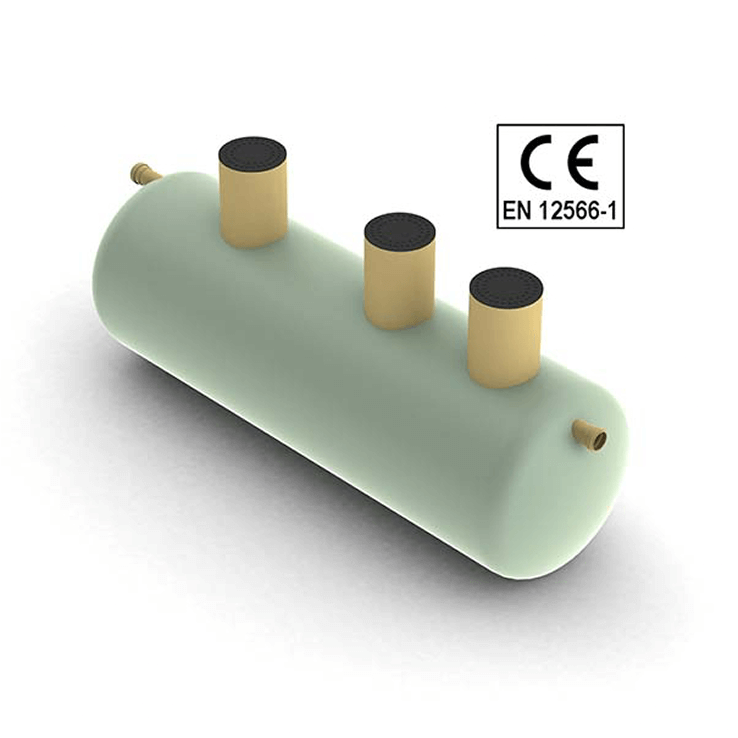
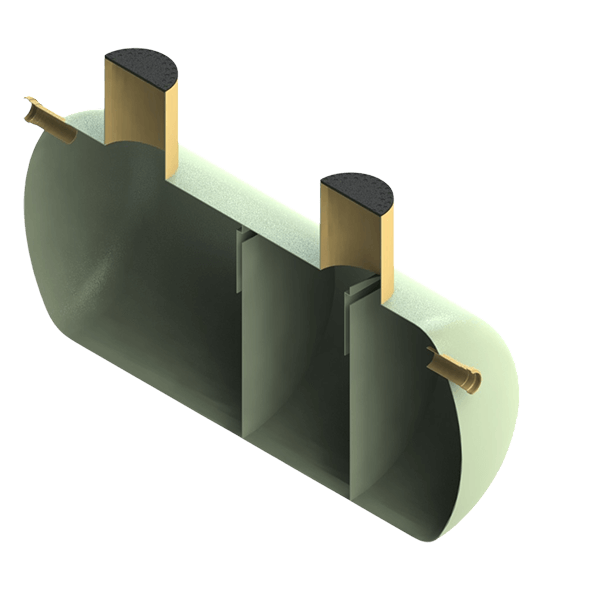
How does a septic tank work?
Inflow
All wastewater from the house flows through a pipe into the first chamber of the septic tank, where the slow flow rate starts the mechanical treatment process.
Settling
Heavy particles sink to the bottom of the tank and form a sludge layer, while lighter matter stays at the top.
Decomposition
Anaerobic bacteria in the middle layer break down organic matter, and the water flows through small openings into the last chamber.
Infiltration
The mechanically treated water flows into an infiltration field or tunnels, where the natural filtration stage takes place.
How to choose a septic tank
1. Determine the number of residents
The first criterion is the number of people who will use the sewerage system every day.
2–4 people: a 2 m³ (2000 L) septic tank is suitable.
4–6 people: a 3 m³ (3000 L) septic tank is suitable.
6–10 people: a 5 m³ (5000 L) septic tank is suitable.
Calculations assume an average water consumption of 150–200 litres per person per day.
2. Calculate water consumption
The septic tank volume should be at least 3 times the household’s daily water consumption. This keeps wastewater in the tank for at least 3 days, allowing heavy particles to settle fully.
3. Assess the soil
A septic tank’s performance depends directly on the infiltration field.
If your property has sandy soil, the system will work efficiently at the standard volume.
If the soil contains more clay or the groundwater is high, choose a larger volume to reduce the load on the infiltration system.
4. Plan the emptying frequency
A larger septic tank means less frequent emptying. Choosing a slightly larger tank (e.g. 3 m³ instead of 2 m³) gives you an extra “safety cushion” when you have guests or use more water than usual.
| Volume | Length | Width | Users | Price (incl. VAT) |
|---|---|---|---|---|
| 2m³ | 2000 mm | 1200 mm | 3-4 | 1650 € |
| 3m³ | 2900 mm | 1200 mm | 4-6 | 1850 € |
| 4m³ | 3750 mm | 1200 mm | 6-8 | 2500 € |
| 5m³ | 4650 mm | 1600 mm | 8-10 | 2890 € |
| 6m³ | 2800 mm | 1600 mm | 10-12 | |
| 7m³ | 3300 mm | 1600 mm | 12-15 | |
| 8m³ | 4300 mm | 1600 mm | 14-17 | |
| 9m³ | 4750 mm | 1600 mm | 16-20 | |
| 10m³ | 5300 mm | 1600 mm | 16-22 |
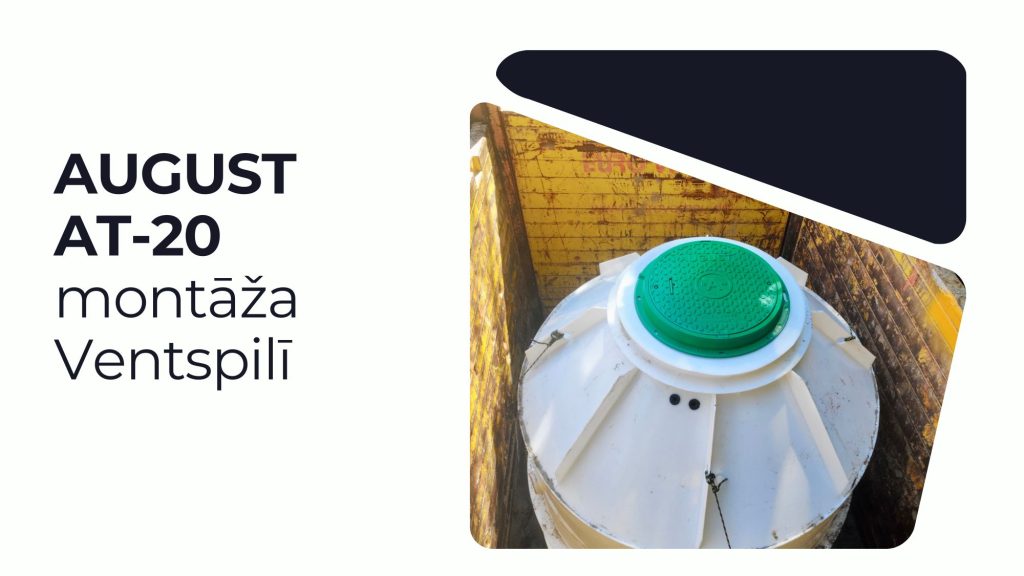
AUGUST AT-20 for a future guesthouse in Ventspils municipality: when an old inn comes back to life.
History meets modern technology It’s not every day we get to take part in a project where new technology gives a second life to a historic building. An interesting project is under way in Ventspils municipality – an old inn…
Read more…